Debt Snowball Spreadsheet: Snowball vs Avalanche Explained (With Example)
If you have more than one debt, the two most popular ways to pay them off are the debt snowball and the debt avalanche. Both work the same way at the start, and they differ in one choice: which debt you attack first.
How both methods work
- List all your debts.
- Pay the minimum on every debt, every month.
- Put every extra dollar toward one target debt.
- When that debt is paid off, roll its payment into the next target. Your payment grows as you go, like a snowball rolling downhill.
The difference is the order:
- Debt snowball: target the smallest balance first.
- Debt avalanche: target the highest interest rate first.
A worked example
Say you have four debts totaling $15,200, and you can pay $600 a month in total:
| Debt | Balance | Interest rate | Minimum |
|---|---|---|---|
| Store card | $1,100 | 26.9% | $35 |
| Personal loan | $2,400 | 12.0% | $75 |
| Credit card | $3,200 | 22.9% | $96 |
| Car loan | $8,500 | 7.5% | $210 |
We ran both methods month by month with the same $600 payment:
| Snowball | Avalanche | |
|---|---|---|
| Debt-free in | 30 months | 29 months |
| Total interest paid | $2,289.71 | $2,132.95 |
| First debt paid off | Month 6 | Month 6 |
The avalanche saves about $157 in interest and finishes one month sooner. In this example both methods clear the store card first, because it is both the smallest balance and the highest rate. After that, the snowball goes for the personal loan (smaller balance) while the avalanche goes for the credit card (higher rate).
This example is for illustration only. Your results depend on your own balances, rates and minimums.
So which should you choose?
Choose the avalanche if you're motivated by numbers and want to pay the least interest. It always costs the same or less than the snowball.
Choose the snowball if you've tried and given up before. Paying off a whole debt quickly feels good, and that motivation keeps a lot of people going. The extra interest is often small, as it is in the example above, and finishing the plan matters most.
The biggest factor isn't the method. It's the size of your monthly payment and sticking with it. In the example, raising the payment from $600 to $700 a month clears the debt in 25 months with either method, 4 to 5 months sooner. It also cuts the interest by about $400.
Tips that help either method
- Stop adding new debt. Put the cards somewhere hard to reach.
- Build a small emergency fund first (even $500), so a car repair doesn't go back on the credit card.
- Use windfalls. Tax refunds, bonuses and gifts go straight to the target debt.
- Track it visually. A color-in debt tracker on the fridge keeps it real.
Work out your own debt-free date
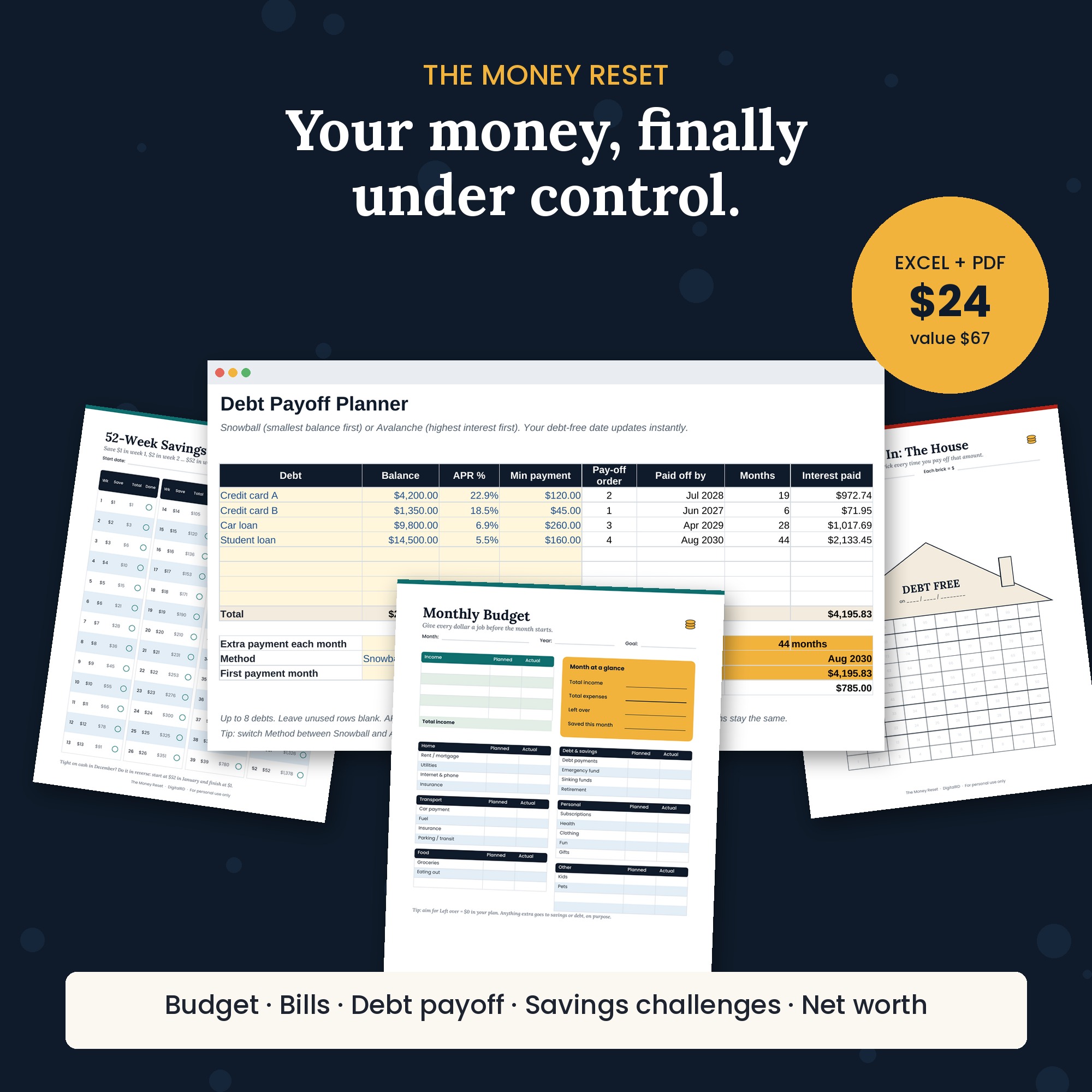
The Money Reset has a debt payoff planner for Excel and Google Sheets. Enter your debts once, and it compares snowball and avalanche side by side and shows your debt-free date. It also includes a monthly budget, a bill tracker, sinking funds, a net worth tracker and printable color-in debt and savings trackers. It's $24 as an instant download.
This guide is general information, not financial advice.